
It was race day. My first Ironman competition in Panama City, Florida was about to start. The competitors were filtering onto the beach from all directions. Waddling like Emperor penguins towards the starting line. Dozens of swimmers were warming up in the choppy waters and hundreds seeking help to get zipped up. The announcement came that the race would start in five minutes and a surge from the back of the pack pushed everyone towards the shoreline. The atmosphere was palpable with nervous kinetic energy. The pros went first and I watched them sprint into the surf. Some pros chose the high hurdle method of getting deeper while others dragged their legs through the oncoming waves.
More amateurs entered the water to warm up as I moved my way to the front of the pack. There were over 2,400 entrants this day. I pushed and squeezed between dozens of rubberized racers on my way to the shore. One racer asked me if this was my first Ironman. Yes it is! “Enjoy this moment.” He said. “Following the start you may wish that you never signed up.” Hmmph. I made my way to the second row. Perhaps, I did not need to be ostentatious enough to command a front row starting point. The man to my right asked me how I was going to do in the swim. I told him with confidence that I expected to win the swim. He asked, “Do you know what they call the winner of the swim at the Ironman?” I shook my head. “A loser. Nobody cares about the swim.”
Welcome to Swimming in the Flood; a podcast where we develop the resilient leader’s mindset by navigating difficult currents in business. My name is Trent Theroux.
I’m not going to lie to you. I was pissed at that guy. Furthermore, I was ready to prove that the swim matters in the Ironman. The announcer revived me when he told us that we were only one minute from the start. The crowd pushed forward and someone three rows back fell over toppling several other racers in the process. Thirty seconds. How was this crowd going to react? Were they going to ease into the water knowing they had a 10+ hour day ahead of them or would they try to take control of the race immediately. Twenty seconds. Most racers hunched over and placed their specially trained forefinger on the start button of their watches. I couldn’t understand this. Why in a 140.6 mile race did you need to start your watch with such precision? “Let’s count down from ten – nine – eight – seven – six – five – four – three – two – one – BOOM!!!!!” The cannon roared and 2,500 people surged from the rear to get into the water.
It was a sprint to get out into the open water. Hundreds of arms and legs flailed around me. The water bubbled as if we were boiling lobsters. I was swimming on top of people pushing them down or pulling them back behind me to get to open water. Where did all the people in front of me come from? I thought I was in the front row on the beach yet there were dozens of people I was clawing through. I could feel the people behind me grabbing for my ankles, a common trick – pull the person in front of you by the ankles and you quickly move ahead of them. I shifted my kicking pattern to keep my feet free. I kicked a few people in the process. Sorry, but they shouldn’t have gotten so close.
After 500 yards, the pack winnowed out and I was able to get into a smooth, aggressive rhythm. I finished 30th out of the water in a little under an hour. Not bad considering that there were 50 or so professional racers at the event.
On the bike, it was a different story. Most of the people ahead of me were professional racers which means they cycle like their driving a Maserati. I was not going to see them again. What I did see was demoralizing. On the streets of Panama City, I developed the nickname “On Your Left.” Cyclists use this phrase when they are passing you. Sometimes the phrase is pleasant, “on your left.” Thank you. Some bark it out as if they are a marine drill sergeant, “ON YOUR LEFT!” The one’s I hate the most are the sugary sweet ones, “on your left. I can’t believe your bike is actually up on two wheels because you are moving so slow.”
Truthfully, I was exhausted. The best energy I had was spent trying to prove someone that I didn’t even know, or could not even recognized if I saw them again wrong. Simple math. My goal was to break 11 hours for the race. The 2.4-mile swim and wardrobe change would take one hour. That meant that there were 10 more hours of racing ahead.
Quick show of hands. How many of you are the type of people that will exert extra energy to prove someone wrong? My magic mirror shows me that there are quite a few of you in the audience. What makes us suddenly feel inadequate in spite of all our training? Why do we feel that we need to prove ourselves to other people, even at the detriment to our performance?
I know a lot of us do this in our personal lives. Heck isn’t that what Facebook is for? Showing the world how good you have it to everyone you know.
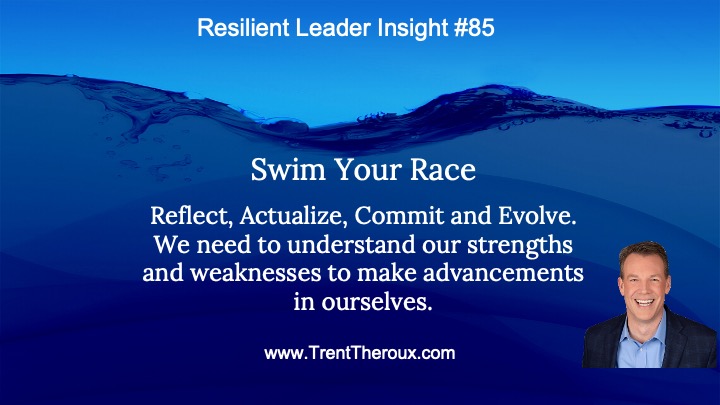
I am now going to give you my unscientific, non-peer reviewed, resilient leader theory on proving to others. Are you ready? Got your pencils out? Here’s it is. Swim Your Race. You heard it. Swim Your Race.
The theory is simple. Sydney Evans author of Run Your Race – uses the acronym RACE to stand for Reflect, Actualize, Commit and Evolve. It is a very simple way of understanding their positioning in their race, in their market. Swimming someone else’s race is very easy to do. We may commonly refer to it as keeping up with the Joneses.
Evans argues that we need to understand our strength and weaknesses enough to understand where and when we should compete. For me as a competitive athlete, and a competitive businessperson, that is often harder than it looks. The will to not compete is hard to obtain. Most of us developing resilient leaders are in our position because we are competitors. Competition to achieve is like a bell to Pavlov’s dogs – we respond when it rings. But, by swimming your own race, perhaps we can still find achievement, just through a different path.
I want to tell you about a company that has started to swim their own race – LG. I was teaching a business strategy class to my MBA students in 2010 and I asked them who was the number one producer of smartphones? Nearly everyone answered Apple. Constant listeners, Apple wasn’t even in the top 5. Their advertising made them feel ubiquitous, but they were not a power player in the industry. Samsung was number one and LG was number two. In 2015, LG slipped to number 5 and Monday this headline appeared – 23 consecutive quarters of losses amounting to $4.5 billion led LG to exit the worldwide mobile phone market.
A $4.5 billion loss. That’s a bad run. Maybe they are now following Sydney Evans’ advice – Reflect, Actualize, Commit and Evolve. Shenjao Jin reported to CNN, “For years, the LG smartphone was known for its unconventional and innovative features. While these features helped LG differentiate itself from other mainstream brands, most consumers did not find much practical value in these features.”
Reflect – LG’s product was number two in the market. They innovated the crap out of our product, including the wide-angle camera lens that everyone now uses daily. However, the majority of their innovations do not appeal to the masses.
Actualize – the reality is that LG lost $4.5 billion dollars, which is about the gross domestic product of Sierra Leone.
Commit – LG’s CEO Brian Kwon wrote, “In the global market, competition in the mobile business including smartphones has gotten fiercer. LG Electronics believe we have reached the point where we need to make the best decision about our mobile phone business, considering current and future competitiveness.”
Evolve. – Kwon added, “Moving forward, LG will continue to leverage its mobile expertise and develop mobility-related technologies such as 6G. Core technologies developed during the two decades of LG’s mobile business operations will also be retained and applied to existing and future products.
Folks, thank you for listening to Swimming in the Flood. Resilient leaders face challenging currents and it is tough navigating, but with one tack or another, we can get there together.