
Shortly after graduating college, I received a great piece of advice from a successful entrepreneur who was in his late sixties. He said, “Trent, you need to make a list of ten important people, write down their phone numbers and keep it in your wallet.”
Much to my surprise, the manager at the liquor store did not make the list. The list he gave me was, “Your lawyer, your accountant, your banker, your parents, your best friend, your mechanic, a cab company, your mentor, a local policeman and your priest.
I scribbled down the list furiously – mentor, policeman, priest – thinking, under what conditions would I need these three. In fact, it sounds like the start to a great joke. Trent calls a mentor, a policeman and a priest. I can’t imagine that the punchline would be any good for me.
I finished the list and told the entrepreneur that I only know two people on this list: a friend and my parents. The entrepreneur said that I would get to know people to fill out the list. That the list, in time, would prove to be invaluable for the day when I needed to call all of them…on the same day.
Welcome to Swimming in the Flood; a podcast where we develop the resilient leader’s mindset by navigating difficult currents in business. My name is Trent Theroux.
In her paper, The Contaminating Effects of Building Instrumental Ties: How Networking Can Make Us Feel Dirty, the author, Professor Tiziana Cascario of the University of Toronto, conducted a study of a large North American Law firm. The results showed correlational evidence that professionals who experience feelings of dirtiness from instrumental networking, relative to those who do not, tend to engage in it less frequently and have lower job performance.
This study made me appreciate that I fall into the “dirty” (can you see my air quotes?) Fall into the dirty category. How do you feel at networking events? Are you one of those that flits from tight circle to tight circle inserting yourself into conversations, shaking hands (pre-COVID) and taking business cards? Dr. Cascario would argue that on average you more likely to have a higher overall job performance.
She identified five types of networking behavior—maintaining contacts, socializing, engaging in professional activities, participating in community, and increasing internal visibility. The study did not drill down to whether these lawyers were personal injury or tax, but I’m sure that you can appreciate the difference between the two.
One of the study’s conclusion showed that the benefits of broader networking, expanding your network led to better job performance because the new resources at your disposal aided your ability to perform your work.
To me, the study explains what the entrepreneur was trying to tell me thirty years ago with his list. Well….it doesn’t exactly explain why I needed a priest.
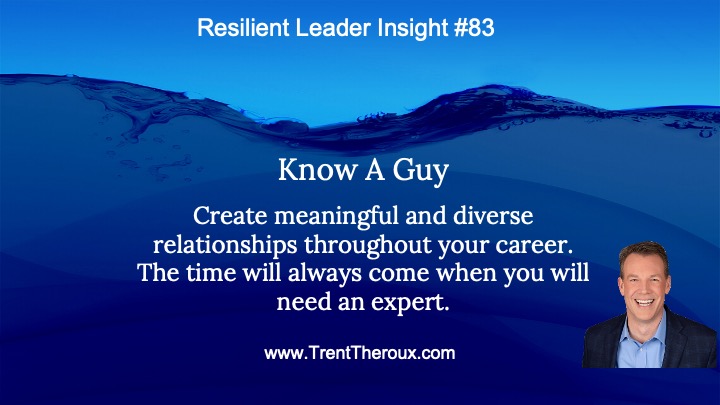
I am now going to give you my unscientific, non-peer reviewed, resilient leader theory on developing social networks. Are you ready? Got your pencils out? Here’s it is. Know A Guy. You heard it. Know a guy.
The theory is simple. Here’s how it works. In the final three miles of my first marathon, my right knee started throbbing. Undaunted, I finished the marathon and enjoyed the satisfaction of completion. After leaving the venue, stiffness in my knee developed and it became painful and awkward to walk to my car.
I took a couple days of rest before I resumed my workout routine of playing basketball before work. After only five minutes of moving around the court, my knee started throbbing. In ten minutes, I was limping and agonizing with each step. There is a line that all athletes know it is the difference between being hurt and injured. Being hurt means that you can gradually work through an issue. Being injured means amputation. No – it means that you may have done longer-term damage to yourself. Today, I felt injured.
I limped for a couple more days fearful that I tore something, an ACL, MCL, one of the “L”’s in my knee. It hurt when I woke up and throughout the day. What I feared the most was that my first Ironman was only a couple of months away. No way was I going to be able to recover from surgery and train hard enough to finish the race. The injury depressed me.
In my book, Fillet to Finish, you can find a few good stories about my Ironman training partner, David Werbel. A week after the marathon, I was at David’s house trying to see if I could go on a bike ride – Spark Notes summary – I couldn’t. Too painful. David said, “Let me help you” and pulled from his wallet a small piece of paper with a list of names. He told me that this was his “team.” His team consisted of a general practitioner, a foot doctor, physical therapist, sports masseuse, nutritionist and right there in the middle was a knee specialist. David says that his medical team keeps him standing upright and ready to race.
For some reason this type of networking didn’t feel dirty, or even mildly wrong. Dr. Cascario writes, “Personal ties are communal-affective relationships that presuppose a general obligation to care for the welfare of the other and thus a willingness to give benefits to please the other, even if doing so provides neither present nor future material rewards.”
Through friends, we can expand our network easier because there is an initial trust that we infer from the referral.
Dr. Razib Khaund was the knee specialist on David’s team. I called him on Monday and limped into his office for a Thursday morning examination. The fate of my Ironman rested in this examination. Heck, what if the tear was so bad that it would affect my ability to do other things like play golf, play basketball with my son, or play golf. By the way, I do not mean to make light of the nervousness over the results of my examination. There are many Developing Resilient Leaders in this audience that anxiously waited for medical news that could change the fate of their lives. So, I’ll be clear. I was waiting for news over whether I could run a race. Small stuff in life. However, at the time big for me.
Dr. Khaund rubbed my knee, rubbed my upper calf and a slight portion of my thigh. He hummed while touching me, maybe even a small whistle. “You don’t need surgery, Trent.” Did I just see clouds parting in the sky. “Do you stretch at all?” The answer was “Duh, no.” Why would I? I’m a young stupid man. “Your IT band is inflamed some simple stretching will resolve the issue in a week or so.” “No surgery?” “No surgery.” “Can I do the Ironman in a few months?” He smiled and said, “I am not stopping you?”
I wanted to gallop home, but something called my IT band kept me limping. At home that night I told my wife about the wonderful results from the doctor and my plans to continue Ironman training…with stretching. She asked me how I found the doctor and I gave her a truly Rhode Island line – Hey, I know a guy who knows a guy.
I know a guy who knows a guy may be the subtitle under Rhode Island’s state flag. It’s the answer to many important networking questions. Dr. Cascario did opine on the effectiveness, or dirtiness of using something like LinkedIn for networking. Quick show of hands, how many of you accept connection requests from people that you don’t know, but are connected to one of your connections? My magic mirror shows me that not very many of you have your hands raised.
Are you declining the connection because you get the feeling that they just want something from you, using you? That’s why I decline those requests. I’m looking for my connections to tell me who I should connect with. I want my connections to tell me who the right people are to include on my team. The people they trust and admire are the people I want to trust and admire.
Speaking of which, do any of you listeners know a good priest I can add to my list?
We as developing resilient leaders have probably done this to ourselves somewhere in our past. How many times have you been in places where you needed to separate yourself from a toxic environment? My magic mirror shows me that everyone in this audience is nodding their heads.
Folks, thank you for listening to Swimming in the Flood. Resilient leaders face challenging currents and it is tough navigating, but with one tack or another, we can get there together.