
Today is my son Max’s 22nd birthday. I let that roll around my brain this morning. My son is 22 and he is my youngest child. Birthdays and anniversaries are great days to reflect back on the influential times of our lives and those with our loved ones.
When Max was younger, the book I read to him the most was Treasure Island. The first time I read it to him; he might have been about seven or eight. He took one look at the size of the book and asked for something different. We were used to reading 20-page books about Star Wars stories.
I started to describe the plot to Max. I told him that the story was about a boy, just a little older than he was who found a map in his mother’s inn. The map described the details of buried treasure from Captain Flint himself. The young boy, his name was Jim Hawkins, Jim jumped onto a boat chartered by a friend of his mother’s along with a scary man with one leg named Long John Silver and they sailed into the Caribbean to hunt for treasure.
Max’s eyes lifted at the prospect of this juicy tale of pirates, gold, kidnapping and sailing. I hooked him. My excitement got the better of me as I started to speculate whether the treasure would still be there, or moved into some cave, or maybe to a different store aisle.
Somehow, this classic tale transported me and a shopping cart to Costco.
Welcome to Swimming in the Flood; a podcast where we develop the resilient leader’s mindset by navigating difficult currents in business. My name is Trent Theroux.
In 2020, Alan King published the study – Treasure Hunting as an American Subculture: The Thrill of the Chase. The paper recounts a 2010 memoir published by Forrest Fenn in which he creates a poem containing nine clues to the location of a treasure chest in the Rocky Mountains worth millions.
King’s study estimated that up to two million people were involved in some level of the chase and nearly half a million were competitive searchers with advanced knowledge of the treasure hunt. King observed that while most (80%) of the respondents showed normal personalities, moods and childhood upbringings, the appeal of the chase raised levels of commitment, satisfaction, knowledge and addition risk.
He’s saying that when there is a chase afoot respondents perk up. They want to be more involved. They want to get in on the action. Is this so different from what Long John Silver wants? Does he care more about the chase or the treasure? This is where Costco come in.
Sarah Nassauer of the Wall Street Journal writes, “Costco is a big fan of using treasure hunt retail psychology to draw you in, which is basically having items on the shelf that are at a, like, wow price because they’re such a good discount, or they’re just really interesting, and they’re not going to be there forever. The big idea behind Costco’s treasure hunt strategy is that by encouraging customers to explore and ensuring that there’s always a new batch of interesting deals, customers end up shopping longer and buying more products.
Have you ever shopped at a Costco? Treasure hunt doesn’t do it justice. The buildings are enormous and there are no signs. Unlike my grocery store, whose aisles tell me that it contains pasta and pie filling, Costco only uses numbers. Don’t go down an aisle and you might miss the greatest bargain of your lifetime.
What also makes this treasure hunt unique is that the average Costco stocks less than 4,000 items at any given time. This compares to your local grocery store that houses 40,000. The treasure hunt pays off as well. The average customer spends nearly three times per visit at Costco versus a large supermarket like Kroger.
Hunting for treasure. Every go shopping for toilet paper and end up buying a coffin? That’s one shoppers experience. Want peanut butter but seduced by a great price on a grand piano? Another great tale.
Developing Resilient Leaders can easily see the benefits of this type of strategy in our business. Giving our customers the hope and promise that there is something unique and valuable hidden in our services gives them the same endorphin rush as Long John Silver.
I see some of this first hand when I describe my platform to meeting planners. Like Costco, all my customers reach me through word of mouth. I don’t advertise. The meeting planners and I will go through a checklist of items that we are going to cover. I perform a deep dive into the company or the organization to learn what makes them tick and what, specifically, they need from my services.
Many times the planner will ask me to give them some details on the stories I will use to deliver my message to their audience. And…I refuse. I ask them if they are more interested in the words I use or how I make the audience feel. Every planner admits to the latter. Every planner may ask for all the details, but they want the experience of finding something special. The same as Costco.
I am now going to give you my unscientific, non-peer reviewed, resilient leader theory on proving to others. Are you ready? Got your pencils out? Here’s it is. Bury A Treasure. You heard it. Treasure.
The theory is simple. Here’s how it works. Most of us don’t have a treasure to bury. Our dogs may bury bones, but none of my friends are out with pick axes and shovels depositing fifties and hundreds into the soil. So let’s think of this in different terms.
I read resumes every day. Resumes from entry level to CEOs and I will tell you it is boring work. I see levels of exaggeration only found by Pinocchio. Each job success is greater than the rest. If I were to believe each resume writer, I would think that they all were a combination of Elon Musk and Mother Teresa. It makes me roll my eyes.
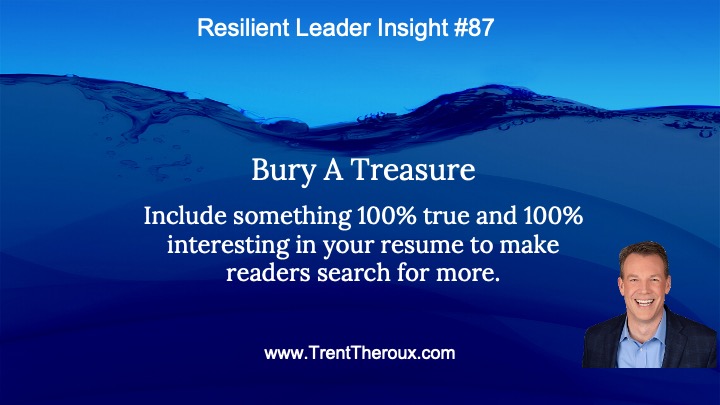
Here’s a suggestion for resume writers. Bury a treasure. Include a nugget of something good, something juicy in your resume that is 100% true and 100% interesting and you will make the reader search for more. Isn’t that what you’re hoping for when you submit a resume? For the reader to keep reading?
You treasure can be something unique about your past, a collection you have a passion you follow. List that you were Lincoln Middle School’s 2002 marshmallow eating champion. I will guarantee you one thing. During an interview, I will ask how many marshmallows you ate. You will be in my mind as the marshmallow champ!
This same theory is usable in our websites and product advertising. Bury a treasure and have your customers go hunting. Perhaps common wisdom is that we should put every salient fact above the fold right in front of the customer. Costco figured it out.
Folks, thank you for listening to Swimming in the Flood. Resilient leaders face challenging currents and it is tough navigating, but with one tack or another, we can get there together.