
My mother was cleaning out the house and found an old passbook savings account at a bank in Newport. (I should make a quick reference for millennials. A passbook is a little banking book in which the bank would stamp your debits and credits and show you your balance. Long before ATMs.) My mother gave me the passbook and said take your girlfriend out with the balance. The account still had sixty dollars in it. It might as well have been gold to this 20-year old.
My girlfriend, Wendy, and I drove to the bank in Newport. We needed to visit the bank because that was the only way to get the money out. On the drive, we talked ourselves into having swordfish. I could taste the butter on my lips. At the bank, I handed the passbook to the teller and waited for my money. The teller put the book into the printing machine and the device started clacking out its numbers. When the machine was done, the teller counted the money and handed me $4.26. I didn’t understand. “The account had over $60 in it.” I told the teller. She agreed, but because it was below their minimum $100 balance there would be a monthly service fee. And, because the account hadn’t been touched for over three years, there were a lot of fees that needed to be deducted. $4.26. I couldn’t believe what the bank had done. The took money from me because they didn’t have enough money from me. I was fuming.
I left the bank and plopped back into my car. Dejected, I said, “Wendy, can I buy you an ice cream?
Welcome to Swimming in the Flood; a podcast where we develop the resilient leader’s mindset by navigating difficult currents in business. My name is Trent Theroux.
Banks love to find ways to do this minimum fees, advance fees, checking fees, foreign ATM fees, overdraft fees. The list is endless. A gentleman that worked for me had a nasty day with his bank a while back. The guy is the sole breadwinner and was a blue collar worker. One day our company’s payroll service did not transfer money into his account properly. Actually, they didn’t transfer any money. The worker was like many paycheck to paycheck guys. The next day his wife did their normal Friday shopping with her debit card. This story is more than a decade ago. Before notices were given that an account was overdrawn. She went to three or four stores and made the weekly purchases. On Monday, he received a statement from his bank that he as being charged $100 for overdraft charges. Four charges $25 dollars apiece.
It didn’t seem fair. The worker didn’t know that he paycheck didn’t get transferred. He didn’t know that his bank was overdrawn. But worse. The bank knew. And the bank allowed it to happen four times. He took time off on Tuesday to go to the bank to explain, but their callous stance was firm, he owed the money. I felt horrible for the man and paid his bank fees.
This type of behavior brings out the worst in companies and it always seems to hit those that have the most to lose. A study in Colorado a few years back showed the effect of library late fees on library membership. They showed that late fees assessed to suburban customer were paid very often while late fees to urban customers were left unpaid.
Let me translate what this study means. The people driving their Audis to the library can easily afford to pay their $10 or $20 late fees. The people taking the bus to the library can’t. Because the fees aren’t paid, they lose access to free internet and learning materials for their children. The economic rung of our society that needs the equalizing effect of literacy is the most punished.
What lesson can we as developing resilient leaders learn from the bank and library example?
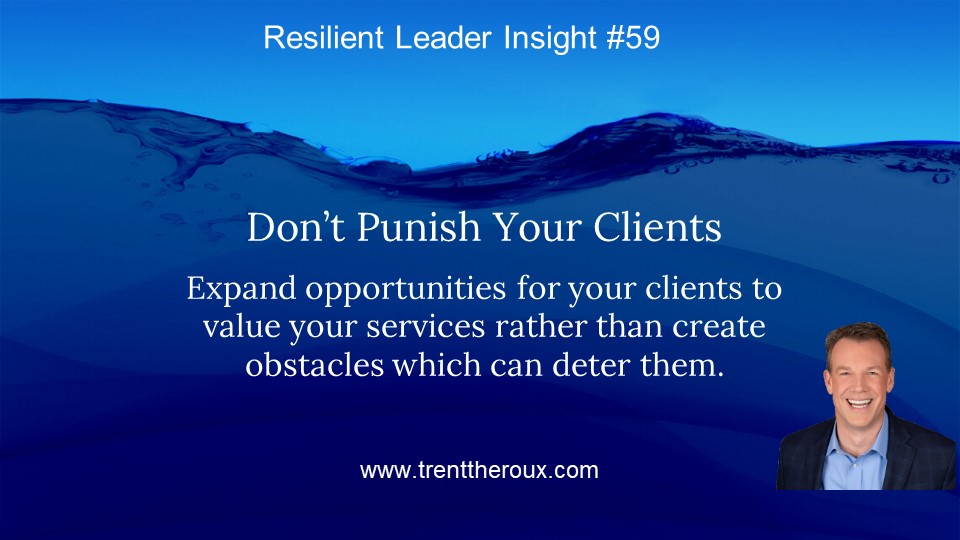
I am now going to give you my unscientific, non-peer reviewed, resilient leader theory on business fines. Are you ready? Got your pencils out? Here’s it is. Don’t punish your customers. You heard it. Don’t punish your customers.
The theory is simple. Here’s how it works. I had a client that was habitually late. Two or three months late. Always. I knew that he was using my account to float his other business operations. One month I decide that I would going to start charging a late fee on his account. And, when his next payment came in I applied the money to his finance charge first and the remainder to his balance. I received a phone call from the customer after we sent a statement reflecting the payment.
Our discussion was amicable. I told him that he was using us as part of his permanent working capital. He agreed. Further, he said that his business was growing and he needed sources of free capital to keep growing. Then, he gave me a lesson I haven’t forgotten twenty years later. He told me, “Trent, do you know how easy it is to change vendors? There are no switching costs to your competitors.”
Investopedia defines switching costs as the costs that a consumer incurs as a result of changing brands, suppliers or products. Although most prevalent switching costs are monetary in nature, there are also psychological, effort-based and time based switching costs. And, in my customer’s case, there were practically none. If gave me pause to think what I really wanted from my customer. Did I want a perfect accounts receivable aging or did I want a lasting relationship that would grow into higher revenues and margins over time? I needed to swallow my lust for punishment in favor understanding that a small amount of leniency can be rewarded in spades.
I want to tell you about a company that didn’t learn this lesson – Blockbuster. In 2010, my wife rented The Blind Side, with Sandra Bullock, to watch as our Friday night movie. Something else came up that evening and we didn’t watch the movie. I had forgotten all about the movie until a little over a month later when I received a letter from Blockbuster informing me that I have now purchased the movie and that I owed them $95. The late fees on the movie had now exceeded the value of the movie! In the letter, Blockbuster informed me that my rental privileges were suspended until I; 1) returned the move and 2) paid the late fees in full.
Now you may not appreciate this but late fees was big business for Blockbuster. In 2000, 16% of Blockbuster’s revenue came from late fees. Almost $800 million per year in late fees. And, since there’s virtually no cost of goods sold the $800 million went to the bottom line. Blockbuster made a full time commitment to punishing their customers. It was easy for them what were you going to do? They were the number one movie distributer in the world.
Well, actually there was something I could to. Switching costs were exceptionally low in this business and I just had a friend tell me about this service called Netflix where you could hold onto a movie for as long as you wanted. Switching was easy. And you know the rest of the story.
Customer relationships are fragile. They require constant nurturing not abusing. We spend years developing customer relationships why would we devise ways to drive them away like the bank, the library and Blockbuster. The customer you take for granted today is the same customer that someone in their garage is trying to provide better service for.
Oh, you may not know this. We moved out of that house in 2017. Do you know what we found? The copy of The Blind Side. It was a VHS copy, so I still couldn’t watch it. Hmmm. Maybe it’s on Netflix.
Folks, thank you for listening to Swimming in the Flood. Resilient leaders face challenging currents and it is tough navigating, but with one tack or another we can get there together.