
It was a week before I graduated college when I was accosted by a stranger at a gas station. I was filling my tank at a station less than a mile away from the capital building in Providence when the man asked if I could help him. He was older than me. Maybe ten years older. He said that he was scheduled to take his driving test today, but his car broke down and wanted to know if I could give him a ride to the DMV. “Sure.” We talked for a few minutes while I was pumping gas. He was cool. He congratulated me on becoming a college graduate. After pumping, we got in my car and started driving towards the registry.
On the very short drive he said, “I need help with one more thing. It’s hard to ask you this, but I’m supposed to bring a car to the registry so they can test me. If I don’t have a car I won’t be able to get my license back. Will you let me use your car?” Now, if alarm bells are going off in your head…well they should be. “I’ll give you $10.” Ten bucks to let him use my car for a few minutes. “Will you help me?” “Sure.” And, he directed me to a side street a block away from the registry.
I got out of the car, with the engine running, the gentlemen came over to my side and got behind the wheel. Before driving off he told me that it shouldn’t take any more than 30 minutes and that he would come back to get me here.
He drove away. It was a nice spring day and I watched the traffic go by. A minute later I stood there thinking, “It is grand theft auto if I gave him the keys?”
Welcome to Swimming in the Flood; a podcast where we develop the resilient leader’s mindset by navigating difficult currents in business. My name is Trent Theroux.
Maybe I have trust issues. Why would someone lie to me? Scratch. Let’s call that a rhetorical question. Maybe I trust too much. Is that a bad thing? Is it bad that we trust people before we know them? Trust people as our first reaction versus skepticism?
Timothy Levine, the chair of communication studies at the University of Alabama, Birmingham would say that my trust is normal. Levine calls what I have the Truth Default Theory, or TDT for short. (And in case you were wondering, this theory is perfect for me because TDT are my initials.)
Levine writes, the basic idea of TDT is that when we communicate with other people, we not only tend to believe them, but the thought that maybe we shouldn’t does not even come to mind. (This sounds very much like my encounter.) Levine continues, this is a good thing for two reasons. First, the truth-default is needed for communication to function. Second, most people are mostly honest most of the time. But, the truth-default makes us vulnerable to deception.
Isn’t this right? Don’t we default to believing people first? Unless there’s a reason our antenna is raised to suspect lying we typically accept what is being told to us. I got caught in this trap in my work. It’s embarrassing to tell this story, but its lessons should help developing resilient leaders break through some of the TDT.
I was hired in August 2001 along with a salesperson for one of our manufacturing divisions. His name was Mike. You wouldn’t know from our jovial first meet and great that in two years’ time I would be talking with the Secret Service and having him arrested for wire fraud.
Mike was a salesman and as with many salesmen there is a proclivity to exaggerate the facts. I guess it comes with the territory. From the outset, Mike improved sales in the department. He developed a strong client in Florida, he was making inroads with a company in China and he was trying to penetrate the Bahamian market. Units were starting to go out the door. Inventories were building, but cash was not coming in.
From an income statement perspective, Mike’s division was doing very well. Increased sales. The margins on the units were strong. But the balance sheet on this division was off. My collection staff couldn’t reach the company in Florida. And Mike asked them not to call China. He said it was because they were 12 hours ahead of us and no one would answer. Mike said that he typically called China at 3:00 in the morning to conduct business and would ask for the money then.
Something didn’t seem right, but nothing seemed wrong. Mike needed to take another trip to the Bahamas to meet with his prospect. I told him that this was his 3rd trip and that I wasn’t going to fund it anymore unless he got us a purchase order for units. The next day we received a large order from Landry’s restaurant group for delivery in three months.
Mike found a new way to sell our units, leasing. He told us that some customers wanted to finance their purchases. Great. He had the leasing company send us a copy of the check they were going to send. The leasing company needed to register the units because they were going to another country and they would send the money when the paper work cleared.
Individually, none of these items raised an immediate red flag for me. Mike was convincing. He was charismatic and engaging. He had an answer for everything. But sometimes, one item doesn’t fit at all and it brings down the whole house of cards.
I received a phone call from my company’s credit card processor who said that someone was trying to place a reverse charge on a credit card, meaning that rather than charge someone’s card for a product or service, they were trying to put money back into someone’s card.
You are probably scratching your head now just as I was then.
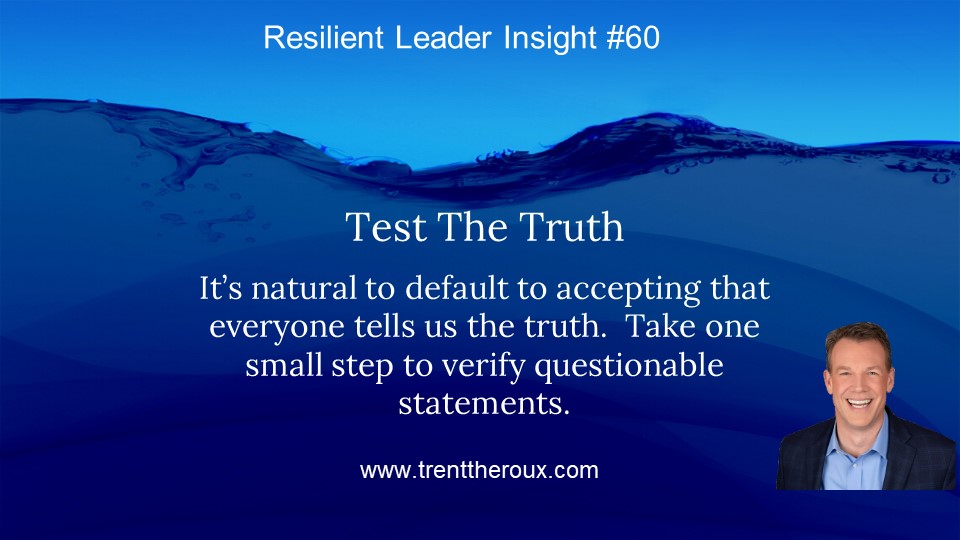
I am now going to give you my unscientific, non-peer reviewed, resilient leader theory on trust. Are you ready? Got your pencils out? Here’s it is. Test the Truth. You heard it. Test the Truth.
The theory is simple. Here’s how it works. I willingly accept that I suffer from Truth Default Theory. This is a hard bias to shake. Levine showed in his work that his subject, in the face of contradictions, accepted that some people were telling them the truth when in fact they were lies all along. President Ronald Reagan, in speaking about the USSR famously said, “Trust but verify.” That’s what we are saying here. Test the truth you are being told.
I asked the credit card company for a few details. First, which machine what the debit coming from. It was the machine located in Mike’s division. Second, I asked for the time of the transaction. The answer was 7:15pm.
I went into the division early the next morning to ask what time everyone went home. Everyone left the building by 5:30, except for Mike. He left at 8:00. I asked him about the transaction. He said that he was trying to process a payment from our China customer, but used the machine incorrectly. Let’s note something here. He’s telling me something that matters to me. I want to get paid by China. He’s telling me that China wants to pay and that he made a mistake on the machine. Both are reasonable to me. Except, that there became too many inconsistencies.
I went and reviewed the check he sent from the leasing company. The bank routing number did not exist. It was fictitious. I reviewed the purchase order he sent from Landry’s. It came in a Word document and the logo was the old one they replaced a year earlier. The gig was up when I called China at 11:00pm. The Chinese company told me that they wired us over $200,000 dollars and that his account with us was paid in full. He forwarded me the wire details. $200k was sent to an account at our corporate bank into an account named Aggressive Energy Management. Mike was the controlling party on the account.
I felt violated. My trust was violated. And, I’m sure that I would have continued to be violated until I began to Test the Truth that Mike was telling me. My next call was to the Secret Service. Mike was arrested for wire fraud and sentenced to six years. It turned out that he previously served four years for credit card fraud. Following his release on my charge, he was arrested for kiting checks and fleecing an auto dealership of their bank account. I won’t say that it’s cold comfort that he duped others. I will say that collectively we all trusted. Mike is still in federal prison and is expected to be released in 2022.
Lastly, remember the guy getting taking his driver’s test with my car? I was standing on the street corner for about 45 minutes waiting. I imagined having to tell my parents that their dumb-ass son gave his car away to someone he didn’t know. I couldn’t believe that Providence College was going to hand a diploma to someone this stupid. Then, he returned my car. I have no idea if he actually even took a driving test. Maybe it doesn’t matter. But, I know that I default to trusting too much.
Folks, thank you for listening to Swimming in the Flood. Resilient leaders face challenging currents and it is tough navigating, but with one tack or another we can get there together.