
Do you remember the Friday night you were in that tiny nightclub outside of Boston watching Jane’s Addiction? There were a couple hundred of you sweating on the dance floor, bouncing against each other in a mosh pit. The music was pumping, and it got turned up to eleven when the dogs started barking at the beginning of Been Caught Stealing.
Someone from the pit climbed up on stage and was singing along with the band – banging their head and pointing out to the audience. He took two steps back and dove face first into the crowd. The moshers coalesced and caught the jumper in the air. You were right in the middle, holding the jumper up above your head, screaming to the music and wanting to get a piece of this high-octane thrill ride.
It may have been the third drink you slammed after leaving work late that gave you the courage to climb up onto the stage. The alcohol rushing through your bloodstream replacing the months of tension caused by completing the programming project you and your team worked on for the past four months. You stood at the edge of the stage – fists pumping in the air. The energy of the crowd urging you forward into the abyss. The surge of adrenaline catches you along with the music and you face your moment of courage bravely and leap body first into the crowd.
In those seconds of weightlessness – those seconds of freedom – were you thinking, what happens if our program launch doesn’t work right?
Welcome to Swimming in the Flood; a podcast where we develop the resilient leader’s mindset by navigating difficult currents in business. My name is Trent Theroux.
Lieutenant Colonel Jason O. Harris developed a brand called No Fail Trust. You can find it at www.NoFailTrust.com. Colonel Harris was a C-130 pilot during the Iraq conflict. He tells a story of an approach he was making carrying 60 marines and two tons of their equipment into Bagdad airport. The C-130 was cleared for landing as they descended from 25,000 down to under 500 feet. Seconds from touching the ground the Load Master gave the command “Go Around. Go Around. Go Around.” What would the next words be out of your mouth? Hmmm?
Colonel Harris said three words to his co-pilot. “Flaps 50%” Harris pulled up on the nose, pushed the plane to full power and climbed away from the runway. It was only after they safely cleared the area did Harris call to the Load Master and ask “why”. He executed the command first and sought an explanation second. He didn’t question the load master in the morning with something like, “Dude, we’re right here. Can’t we just land and go out for a beer?” He executed the command first and sought an explanation second. How many of us developing resilient leaders would have followed that course of action?
It’s easy to rationalize his actions be thinking that it’s military protocol and we have to follow orders. Perhaps, but Colonel Harris would tell us that it is more. There are several pillars of his No Fail Trust training. The first is Trust the Training. Whether it’s athletics or academics. Whether it’s machinery or military. We are given training. Training that it intended to shape our minds, our bodies, and our hearts to conform to a prescribed set of rules. Trusting the Training is intended to condition us to have a mental checklist ready – clear instructions of how to act and react to varying circumstances.
Trust the Process. In our organizations we need to develop processes and protocols that clearly identify the rules of engagement. Trust the People. We need to develop faith in the people that are responsible for us and that we are responsible for to know, through their proven experiences, that they are seeking the same outcomes as you.
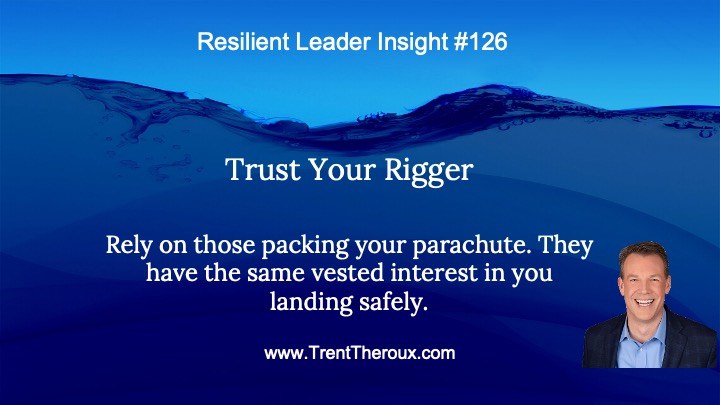
I am now going to give you my unscientific, non-peer reviewed, resilient leader theory on trusting your team. Are you ready? Got your pencils out? Here’s it is. Trust Your Rigger. You heard it. Trust Your Rigger.
How many of you have jumped out of an airplane? My magic mirror shows me that not many of you have. Why is that? Why are you afraid to jump? I can hear some of your reasons now. Fear of heights – that probably tops the list. Why jump out of a perfectly good plane? Sure. That’s up there on the list as well. What if the parachute doesn’t open? Ohhh…that one has some credibility. I cannot think of many things more frightening than falling thousands of feet with the knowledge that I’m going to hit the ground at 130 miles per hour.
The Federal Aviation Administration has a manual titled the Parachute Rigger’s Handbook. There are over 350 pages of regulations on how parachutes should be rigged. Quick question…when was the last time you read every word of a 350-page book? I’ll give you one guy. His name is Ted Farnsworth. Ted has been rigging parachutes for over 40 years. According to Ted, “the first season of my skydiving career, I watched a friend die due to a rigger error. I realized at that time that I did not know what I was looking at or what went wrong with his gear. I decided I had to either quit skydiving or learn about parachute equipment. So, I took a rigging course. After the rigging course, I decided to keep skydiving, but I felt uncomfortable packing a reserve without direct supervision. It took me 17 years to overcome my reticence to pack a reserve without someone checking my steps. Every time I pack a reserve, I close my eyes and I see my friend going right in front of me, so I take this job very seriously.”
Right, do I Trust this Rigger? You bet I do. Ted has been carefully trained. Ted has followed this process for 40 years. And I trust Ted as a person. He knows what will happen if he fails to do his job. Isn’t this the type of trust we are seeking in our work environments? Trusting Our Riggers.
Let me give you one more example. In the early morning hours of June 6th, 1944, over 18,000 paratroopers crossed the English Channel and prepared to drop into Normandy. Their 1,200 planes were under a barrage of constant anti-aircraft fire. Bullets pierced the fuselage and killed some of the paratroopers while waiting in the queue to jump. In the moments before reaching their drop zones, the jump master would yell, “Check Rigging!” It became the responsibility of the person standing directly behind you to check your parachute. The person who was ready to jump right behind you. The person who would be the first to see if your chute opened or not – that is the person with whom you had to trust their training, trust their process and trust them.
Now, let’s go back to the bar. The music is still thumping. You’re standing on the stage head banging with Jane’s Addiction and looking out over the crowd. Maybe you should ask yourself this – how has the crowd been trained – or what is the mosh pit’s process for catching me – or do I even trust these drunks? Are we jumping just because Jane’s Says or because we Trust our Rigger.
Folks, thank you for listening to Swimming in the Flood. Resilient leaders face challenging currents and it is tough navigating, but with one tack or another we can get there together.