
Do you set your watch several minutes ahead of time, so you’ll never be late? This might be a silly question because I don’t imagine many of you are wearing watches right now because you keep time on your phone. Maybe it’s a better question for our parents. Did they set they clocks ahead so they wouldn’t be late?
This was a regular habit before the invention of the iPhone. People had control over the time based on how they set their clocks and watches. It was like they were Doctor Strange moving through the multiverse.
I knew someone who set their alarm clock twenty-seven minutes ahead so that they could hit the snooze button three times before it was their actual time to get up. Think about the logic here. Make the time on your clock wrong so you can lie to yourself about the actual time. It might be an alternate definition of insanity…
Welcome to Swimming in the Flood; a podcast where we develop the resilient leader’s mindset by navigating difficult currents in business. My name is Trent Theroux.
According to a Keri Systems survey, tardiness costs the U.S. economy nearly $3 billion a year. When you consider that up to 20% of workers are regularly late to work, this staggering sum becomes easier to believe. HR organizations estimate that 20% of your workforce arrives 10 minutes late at least twice a week, resulting in employee productivity losses of $500-$600 per employee per year.
The lateness goes further than just financial repercussions. Lateness affects productivity and morale. Often, co-workers are forced to pick up the slack of late employees, causing them to harbor resentment and could encourage them to turn up lates as well.
Perhaps the worst thing that could happen because of lateness would be to have your mother ground you for a week in the summer. And it wasn’t even your fault! Maybe I should give you a little background.
In the early 1980s, Colt State Park in Bristol, Rhode Island built a large stage in front of Narragansett Bay and ran a concert series for a few years. They drew great names like Jackson Browne, Stevie Nicks, The Beach Boys and Crosby, Stills & Nash. In August 1983, I went with a couple of buddies to see Crosby, Stills & Nash, not because they were my favorite band, but because we could ride our bikes into the park and sneak into an adult concert.
The opening act that night was The Band, yes the band’s name was The Band. You’ve probably heard some of their song in commercials. Songs like “I pulled into Nazareth, was feelin’ ‘bout half past dead.” And other folk-rock songs. They open and I find that I knew quite a few of the songs. Some that I could sing along to. It was a glorious late summer night, outdoors, with a calm ocean breeze.
The Band played for a while and I was getting itchy to sing Southern Cross and Our House by CSN, but The Band kept playing. The sun completely set and twilight faded and The Band kept playing what sounded like a song that they already played. I looked around to see if anybody caught this but my senses were confirmed when they played Up On Cripple Creek for the second time. Why were they repeating songs?
At this point, the audience’s mood started to shift a little. There was grumbling. Cat calls. Yells to the stage for CSN. After another 20 minutes, Graham Nash came onto the stage – to a great applause – and explained that David Crosby hadn’t arrived yet, but his tour bus did just leave the hotel in Providence. He also said that The Band would play a little longer, to which the crowd was less than enthused. I suspect that if this happened at a Public Enemy concert, the outcomes would have been different, but most of these middle-aged hippies were chemically mellow and seemed to go with the flow.
Fifteen minutes later, Nash came back on stage and pointed out that Crosby’s bus was here and needed to come through the crowd. The paved access way to the stage entrance ran right through the audience who loudly banged and pushed on the tour bus as it passed. Nash suggested to the crowed that we give David a good razzing when he got on stage.
A while later the trio took the stage and introduced each other. When Steven Stills introduced Crosby, the crowd booed and screamed epithets to the stage. There was a cacophony of drunken frustration in the crowd. Crosby grabbed the microphone and yelled, “You want me to get back on the F’ing bus?” The crowd grew deadly silent and swelled to a chant of “Crosby, Crosby.” The show was great. The trio’s harmonies were beautiful and when they played Southern Cross, the boats in the bay shot off their flares and lit up the night sky.
My friends and I biked back home humming songs from the concert. My mother was awake when I was home and informed me that I was an hour late. She did not appreciate my David Crosby excuse and grounded me for a week. To this day. To this minute, I am pissed because David Crosby got me grounded because he was late!
I am now going to give you my unscientific, non-peer reviewed, resilient leader theory on admitting failure. Are you ready? Got your pencils out? Here’s it is. Run On Lombardi Time. You heard it. Run On Lombardi Time.
Here’s how it works. Vince Lombardi was the Hall of Fame head coach of the Green Bay Packers during the late 1950s into the late 1960s. His coaching record was monumental, and he led his team to victory in the first two Super Bowls ever played. Heck, they named the Super Bowl trophy after him he was that good. The Lombardi trophy.
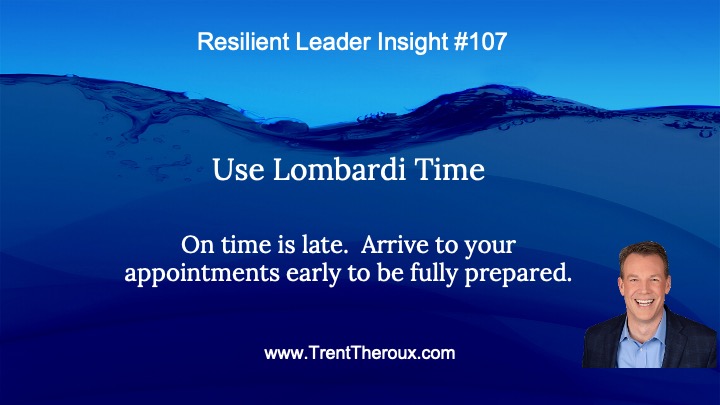
So, what’s Lombardi time? Lombardi always taught his players and coaching staff they should arrive fifteen minutes early to a meeting or an appointment. This extra time allows you to prepare and collect your thoughts. If a team meeting started at 5:00, Lombardi expected everyone to be present at 4:45. If a player arrived on time, he was late. Many of former Green Bay players and coaching assistants claimed that “Lombardi Time” taught them discipline and helped them to appreciate how the value of their time.
This discipline can have the same value in our lives. How often have you watched someone walk into a meeting a few minutes late and start with, “What did I miss?” Does that irritate you? It irritates the hell out of me. By using Lombardi time, you can set the example for your teammates by showing them you are prepared and ready to tackle the next challenge facing you.
The dynamic has changed recently that has the potential to affect Lombardi time, it’s the tsunami of Zoom and Teams meetings. Thanks to the COVID revolution, many of us don’t need to go to a meeting room. Our computer alarms tell us when it’s time to log into a meeting. This is very different. Let me ask. How many times have you been in one meeting and said, “I’ve got to pop off because my next Teams meeting is going to start?” My magic mirror shows me that nearly all of you have your hands raised. The Lombardi rule still applies. Clicking on when the meeting starts means that you are physically, nay virtually present, but that doesn’t mean you are prepared, Lombardi prepared.
Here is my suggestion. Plan for your Zoom meeting to end fifteen minutes before your next meeting. No, wait Trent we can’t do that. We’ve got important meeting stuff to discuss and work through. Nonsense – Nonsense. Ask yourself, if everyone was prepared at the beginning of your meeting would you be rushing to finish on time? I think not. Use Lombardi Time. Develop the discipline to prepare for your meetings and you might find they are significantly more productive.
Developing Resilient Leaders, there is so much time to make up every where we turn. Time we have wasted on the way. Actually, I’m going to let my dear, now departed friend, David Crosby tell us.
Folks, thank you for listening to Swimming in the Flood. Resilient leaders face challenging currents, and it is tough navigating, but with one tack or another we can get there together.