
My local gym was packed this week, packed. There were lines of people waiting to use the treadmills and the stair climbers and the ellipticals. It’s typically for early-January. People trying to honor their New Year’s resolutions – for a little while at least.
I get my turn on the stair machine. It’s in the back of the gym and I can watch everyone working out, waiting to work out, scanning their phones between sets, stretching, some are faces I’ve seen here for the past couple of years others are learning the machines for the first time. I think about the new members. How many are here because of their new year’s resolutions only? How many of them want to be here? Probably not as many as are here. And I wonder how many will try to keep up this newfound workout routine next week?
Welcome to Swimming in the Flood; a podcast where we develop the resilient leader’s mindset by navigating difficult currents in business. My name is Trent Theroux.
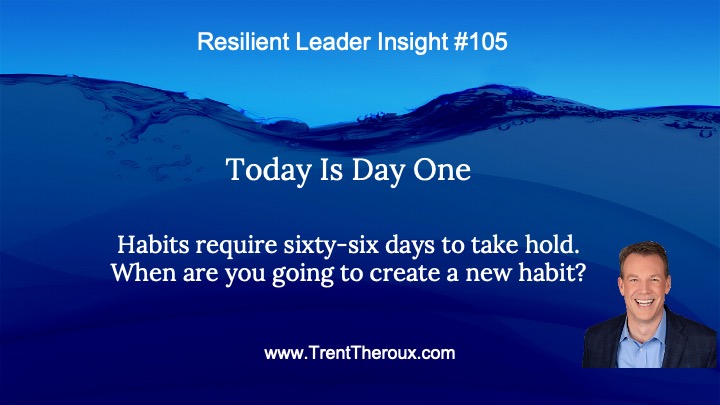
According to the Phillippa Lally in the European Journal of Social Psychology, it takes on average 66 days for a new behavior to become a habit. The actual range of their study showed that a habit can be formed in between 18 and 254 days. The study she used was to find whether it was easier for participants drink a cup of water with breakfast or do 50 sit-ups after drinking their morning coffee. Quick question? How many of you would take the sit-ups option? My magic mirror shows me that there are as many hands raised as people in line at my gym. Good for you.
The study found that repeating a behavior in response to a cue appeared to be enough for many people to develop the automaticity for that behavior. This would mean that in time, drinking your coffee would make you want to do sit-ups or while preparing your breakfast you would also pour yourself a glass of water.
Here’s a habit we all have. Next time you park your car, stand outside the driver’s door and ask yourself “where are the car keys?” It may be a stupid question because the answer most likely is “in your hand.” How did they get there? Did you consciously think about putting the car keys in your hand when you left the car? No, you created a habit that cues you to take the keys out of the ignition when you park the car.
Isn’t this what New Year’s resolutions are about? Creating habits? Correction. Creating good habits? I want to lose 15 pounds. I want to find a better job. I want to travel the world. I want new lover.
One New Year’s I made a resolution that I was going to read a novel a week. Quick note. This was before I had children so I had lots of free time to read. Now, because I’m the type of person who like to chunk out my assignments, I did some simple math on my reading requirements. A typical novel is 350 pages which means that I need to read 50 pages a day, every day for a year. Simple enough for a guy whose biggest responsibility at the time was to wake up at 7:00am to go to work at a bank.
In late January of that year, CBS was airing Stephen King’s It in a two-part miniseries. My roommate was an avid Stephen King reader and we watched the first night’s episode together. The movie was riveting. Tim Burton as Pennywise the Clown was absolutely frightening, even for a really macho twentysomething year-old like myself. When he said, “Hey Georgie! We all float down here.” I could feel the hair on my legs standing. My roommate told me after the movie that the book way scarier than the movie and went into her room to pull out her copy for me.
Well, it was Monday night, and I needed a book to read for the week so I started It…and fell asleep around 3:00am. My alarm went off at 7:00am as usual and my mind raced back to Derry, Maine and the junior high school children who were experiencing the misdeeds of Pennywise. It was Tuesday morning and the second half of the miniseries was to air on Wednesday night.
My goal for the year was to read 52 novels for the year. It was going to be number 4. Remember the simple math? Average novel is 350 pages, that’s 50 pages per day. Except, Stephen King doesn’t play along with that average. It is 1,150 pages. Essentially, the book is three weeks of novels in one.
Of course I made the rationale decision for someone early in their twenties. Because I wanted to read the book before I watched the ending, I needed to take the day out of work to finish reading. Make sense to you? Well, it did to me at the time. I mustered up a fake cough and I was free for the day. (I will admit. This was not one of my finer leadership moments.)
The book was worth a day off. If you enjoy coming-of-age stories blended with terrifying horror this is the book for you. From there, I went on a Stephen King kick and plowed through ten or so of his books over the next couple of months. Ultimately, I made my goal of 52 novels, fifty-ish pages a day.
I am now going to give you my unscientific, non-peer reviewed, resilient leader theory on starting good habits. Are you ready? Got your pencils out? Here’s it is. Today is day one. You heard it. Today is day one.
Here’s how the theory works. Habits don’t happen automatically. They happen gradually over time. Dr. Maxwell Maltz, in his 1960 work titled Psych-Cybernetics, wrote that commonly observed phenomena tend to show that it requires a minimum of about 21 days for an old mental image to dissolve and a new one to gel.” Maltz didn’t perform a scientific study to reach this generalization. Rather, he observed his patients.
Getting to day twenty-one starts with day one. Whatever item you are seeking to change in your life, weight, smoking, education, relationships, work environment, whatever, Developing Resilient Leaders need to tell themselves that today is day one. Day one towards making a new and lasting habit.
One book that has influenced the writing of my podcast is Stephen King’s On Writing. Twenty years ago, Stephen King was struck by a van and nearly killed while walking down a road near his house. After the accident, King struggled to return to writing and feared that he would never publish another novel. Instead, he wrote a manual on how to write. From this release of energy and anxiety, King was able to rediscover his ability to craft stories.
There are two items I took away from this book that are pertinent in our story today. First, King requires himself to write 2,000 words per day. That is his quota. (For perspective, each of these podcasts are approximately 1,500 words.) He does not leave his office until his work is completed. When you notice that he’s written over 80 novels, you can appreciate that you can’t be that prolific unless you make a habit of your work.
Second, King wrote, “If you don’t have the time to read, you don’t have the time or tools to write.” I took this line to heart. “If you don’t have the time to read, you don’t have the time or tools to write.” This quote means more to me than just writing for my podcast. I look to it as a business lesson. If we don’t have the time to read. We don’t have the tools.
One last note today about Stephen King’s writing. At the back of each book, you will read the dates that he started and finished. It was started in June 1981 and finished in April 1985. During that time span, King was writing at least 10 different books at the same time! Including classics like Cujo, Christine and Pet Semetary. My point is that when King came to a stumbling block in writing, he didn’t break his habit, he merely shifted his focus while retaining his habit.
As we are marveling at King’s work today, I would be remiss if I didn’t introduce you to my good friend, Pennywise the Dancing Clown.
Folks, thank you for listening to Swimming in the Flood. Resilient leaders face challenging currents and it is tough navigating, but with one tack or another we can get there together.