
In the fall of my junior high school year, the school announced an open chess tournament. Students would compete in a single elimination game with the winner of that to play against members of the chess team.
Swimming season hadn’t started yet so I had some afternoon free time to play and I registered. I had played chess since I was a youngster, mostly against myself. Well, as an only child, and only three television channels, all playing religious programming on Sunday mornings, there was nothing else to do. Invariably, my games always ended up with one king chasing the other king. That’s what only children do.
Eight students registered for the tournament which meant three wins to take on the chess team. Two of the players barely knew how the pieces moved and the third was only marginally better. As winner of the student group, I would take on the chess team starting with the 5th ranked player. The winner of that match would play against #4 and so on.
Something bizarre happened during my match with number five. The chess coach took my opponent’s king and laid it down on the board. “You resign.” He said to number 5. And like that, I moved up a board. Number 4 got his pawns taken out early with my knight and we moved to number three. This young man, a freshman I think, made his moves without even thinking, it seemed. And, before long the chess coach laid down his king.
The number two player was my year. A casual friend I knew from my math classes. I took his queen with my 11th move. I had a smug smile knowing this was over and I was going to take on the school’s top chess player. Then, my pieces started dwindling. Every move I made seem to be right into a spot where number two was waiting. My pieces became blocked with nowhere to attack and run. I couldn’t see the escape. But I could see the Chess Coach watching. And, I could see him take my king and lay it down.
Afterwards, he complimented me on my game. He told me that I should have won the last match then asked, “what was your end game?” “I don’t know what that is.” “Well,” he replied, “that’s the problem right there.”
Welcome to Swimming in the Flood; a podcast where we develop the resilient leader’s mindset by navigating difficult currents in business. My name is Trent Theroux.
I left the chess matches that afternoon still wondering what an end game was. Now, decades later, I understand it a little better not so much in chess, but in corporate strategy and negotiations. Endgame can be defined as the final stages of a chess game after most of the pieces have been removed from the board. While it’s most used in chess, strategy and negotiations play out very similarly.
Quick show of hands – how many times do you enter a negotiation with exactly what you want already planned out. My magic mirror shows me that…most of you have your hands out. Of course you do. You’re Developing Resilient Leaders! Last episode we talked about checklists. Every one of you (hopefully) has a checklist of items they want to achieve, or negotiate for. Now, quick show of hands – how many times to you enter a negotiation knowing exactly how your negotiating partner will respond? Hmmm. My magic mirror shows me that…there aren’t as many hands raised. Why do you think that is?
Here is a quote that I think of quite often when I’m preparing for a negotiation and I will tell you that it has served me well over the years. It’s from Abraham Lincoln. “When I get ready to talk to people, I spend two thirds of the time thinking what they want to hear and one third of the time thinking about what I want to say.” Doesn’t this sound like the exact opposite of how most people enter into a negotiation, an argument or a strategy session. Can’t you just hear cries of, “Let me tell you another thing.”
Planning for how a market will react to your strategy is paramount to achieving a successful implementation. Thinking about the potential variations, influences, obstacles will prepare Developing Resilient Leaders to make better, stronger strategies.
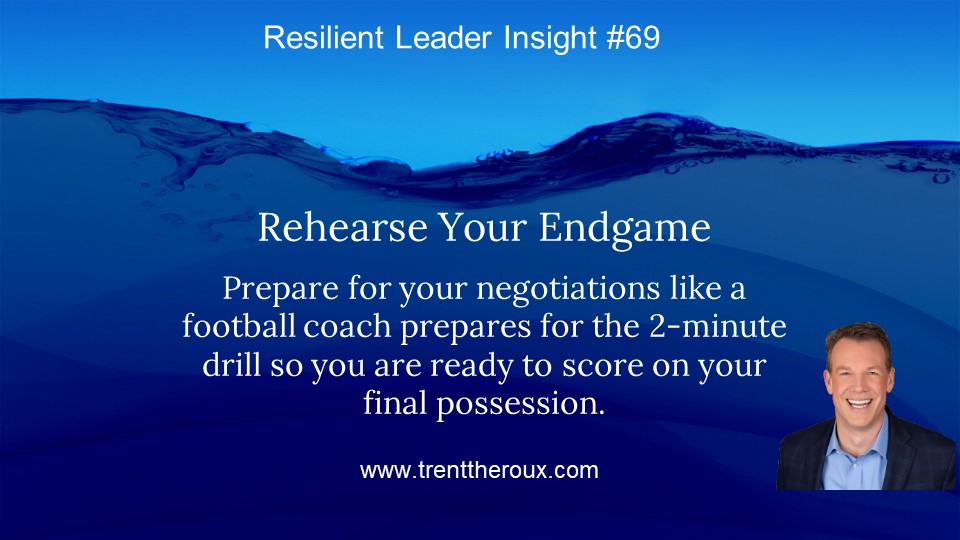
Here is my unscientific, non-peer reviewed, resilient leader theory on preparing the final stage of strategies. Are you ready? Got your pencils out? Here’s it is. Rehearse Your Endgame. You heard it. Rehearse Your Endgame.
The theory is simple. Here’s how it works. I recently watched The Queen’s Gambit on Netflix. A delicious, slow burn about a female chess prodigy in the 1960s. In one of the climatic moments of the series (note – I am not going to give away any spoilers), the lead Beth Hanson was at an adjournment in a match with the world champion. Quick explanation…
Most chess matches start out following a script depending on if you are playing white or black. Variants of opening moves have been recorded and replayed in millions of matches over hundreds of years. The average chess opening contains 10 moves from there it moves into the middle game. The opening is about memorization. The middle game is about intelligence and improvisation. It is here that the game takes its shape. One player bending the other to his will.
Players may ask for an adjournment to take a break from a game. Remember, at the highest level, these games are hours long under intense mental pressure. Quite often, the adjournment is used to study how the player plans to close out their opponent. They are moving though the variations and variants of the remaining game to identify the best path to victory. The end game strategy to defeat the other player. In the Netflix series, this becomes one of the climatic moments as Beth Harmon is rehearsing her endgame. Rehearsing the moves and counters she will make to vanquish her nemesis.
There’s another place that Rehearsing The Endgame is seen more frequently to much larger audiences than regional chess tournaments. It’s on every Sunday in the fall. I’m talking about the National Football League.
Your team is down by two points with 2:05 left on the clock in the 4th quarter and the ball is on your own 15-yard line and you have two timeouts. What happens? There’s a large majority of Developing Resilient Leaders who can answer this question easily. It’s become almost second nature to you. Your team needs 50 or so yards to get into field goal range. You get an extra time out at the 2:00 warning. You’ve seen this plenty of times. Now ask yourself, why does it work so often? Why are there so many game winning field goals as time expires?
The answer is simple. Football coaches spend considerable hours of practice on their endgames. Players and coaches condition themselves to be in the moment when the game is on the line. They rehearse the exact plays, or variations, they will use to move the ball down the field. At no other time during the game does the team seem as focused as during the 2:00 drill. Have you ever noticed that?
Having a plan for controlling the clock and closing out the game, having an endgame for your strategy will prove vital for your success – and potential glory.
Here to explain the result is my dear friend, the voice of the Patriots, Gil Santos.
It’s hard to believe that was nearly twenty years ago.
Folks, thank you for listening to Swimming in the Flood. Resilient leaders face challenging currents and it is tough navigating, but with one tack or another we can get there together.